2026 Top Stainless Steel Sink Manufacturers for Buyers

Choosing a Stainless steel sink manufacturer involves more than comparing catalog photos or quoted prices. Buyers need to assess material grade, bowl dimensions, fabrication quality, and the support available after delivery. A sink may look identical online yet feel different in use. Check the rim, corners, drain opening, and underside finish on a physical sample whenever possible.

This 2026 guide introduces manufacturers for residential, commercial, and project-based purchasing. It considers practical factors such as product range, customization, production capacity, quality-control processes, and export experience. Ask suppliers for material specifications, inspection details, warranty terms, and clear lead times. A useful comparison should distinguish documented capabilities from sales language. Small details matter.

Still, no specification sheet tells the whole story. A polished finish can hide uneven workmanship, while a low quote may exclude packaging or required accessories. Buyers should verify claims directly and compare like-for-like models before making a decision. The manufacturers covered here are starting points for research, not automatic recommendations. Your best choice depends on installation needs, order volume, budget, and the supplier’s ability to communicate clearly when something changes.
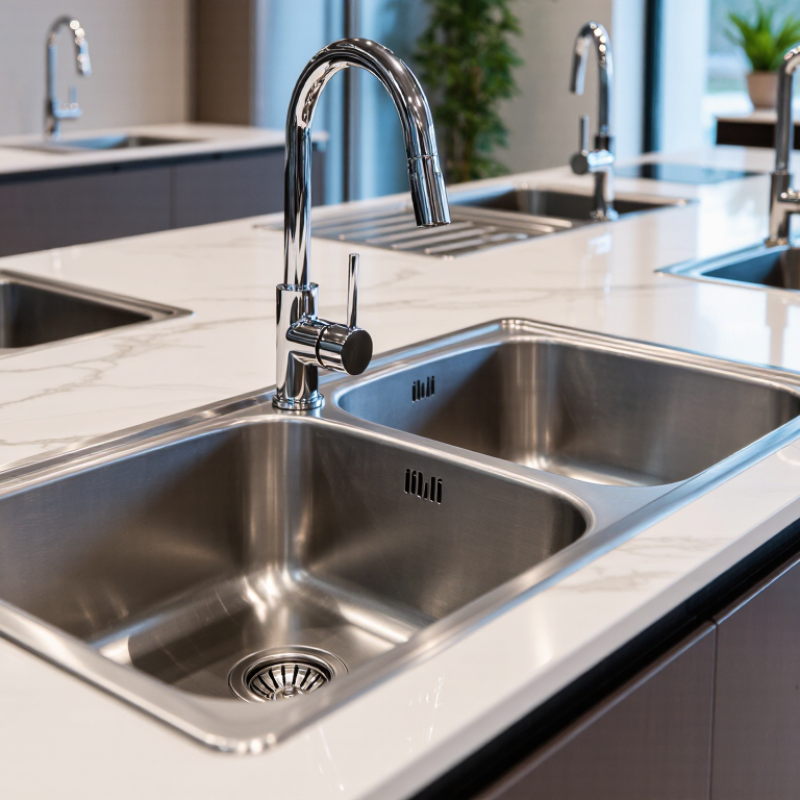
2026 Top Stainless Steel Sink Manufacturers for Buyers

Understanding the 2026 Stainless Steel Sink Market

Understanding the 2026 stainless steel sink market means separating material supply from buyer demand. World Stainless reported global stainless steel production of 62.6 million tonnes in 2024, a 7% year-over-year increase. That signals broad material availability, not sink sales. Important distinction. For buyers, the figure offers context, but it cannot predict prices or factory lead times on its own.

Housing activity provides another clue. The U.S. Census Bureau and HUD recorded about 1.36 million U.S. housing starts in 2024, down 3.9% from 2023. This is an imperfect proxy: it misses renovation purchases, which also drive sink replacement. When comparing manufacturers, check steel-grade documentation, sheet thickness, bowl depth, drain placement, and sound-dampening pads. Ask whether thickness is measured before or after forming; the detail is easy to miss. Inspect brushed finishes under direct light, where uneven grain becomes visible. Factory capacity alone proves little. Samples can look better than repeat production, so specify inspection tolerances and batch records.

How Stainless Steel Sink Manufacturers Are Evaluated

A reliable sink evaluation starts with traceable steel, not a shiny showroom sample. World Stainless’ Stainless Steel in Figures 2024 reports global crude stainless steel production of 58.4 million tonnes in 2023. That scale signals broad material availability, but it does not prove a particular sink’s quality. Ask manufacturers for mill test certificates and confirm the stated grade against ASTM A240/A240M, which covers stainless steel sheet and strip. Check the actual sink, too. A magnet test alone cannot identify its grade.

Fabrication details matter at the corners. Inspect welds for pinholes, sharp edges, and uneven polishing; run a cloth across the rim to catch burrs. Compare bowl depth, drain alignment, and thickness measurements with the technical drawing. Request documented checks for leaks and dimensional tolerances, plus sample inspection records from recent production. For noise control, ask what damping material is used and where it is placed. A sample may look excellent while hiding inconsistent production. I would treat one approved sample as a starting point, not proof of repeatable quality. ISO 9001 certification can indicate a quality-management system, but buyers should still review inspection records and verify that the documented process covers the sink line.

Leading Stainless Steel Sink Manufacturers to Know in 2026

In 2026, leading stainless steel sink manufacturers are distinguished less by polished catalogs than by repeatable production. Buyers should look for clear steel-grade documentation, consistent bowl dimensions, and traceable inspection records. Ask how each manufacturer controls sheet thickness, corner radius, weld quality, and surface finish. Small differences show up at installation.

Details matter. A well-made sink should have smooth, even edges and drainage that directs water toward the outlet without leaving persistent puddles. Request a sample or detailed production photos, then inspect the underside, sound-dampening pads, and overflow openings. Manufacturers with reliable quality processes can explain how they check these features across production batches, not only on display models.

Compare warranty terms, packaging, and communication alongside price. A supplier may offer extensive customization, but confirm that changes will not affect lead time or replacement-part availability. No manufacturer is perfect. A showroom sample can look flawless, yet actual batches may vary; ask what happens when measurements or finishes fall outside agreed specifications. Clear answers are a useful sign of a dependable manufacturing partner.

Stainless Steel Grades Used in Sink Manufacturing: Chromium and Nickel Content

Specified composition ranges for common stainless steel grades, shown as percentages by weight. Composition is one factor to consider; it does not by itself determine a sink’s overall quality or performance.

Source: ASTM A240/A240M stainless steel plate, sheet, and strip composition requirements. Grade 430 nickel is shown from zero to its specified maximum of 0.75%.

Comparing Product Quality, Designs, and Customization

For buyers comparing stainless steel sink manufacturers in 2026, product quality begins with verifiable specifications. The World Stainless Association’s Stainless Steel in Figures 2024 reports 58.4 million tonnes of global stainless crude-steel production in 2023. That figure shows the material’s scale, not a sink’s durability. Ask manufacturers to identify the steel grade, sheet thickness, and finish, then check whether sample edges feel even and welds look clean. Details matter. A polished surface can still hide thin walls or uneven finishing.

Design choices affect daily use. A deep single bowl can fit a roasting pan, while a divided bowl helps separate washing and rinsing. Houzz’s 2024 U.S. Kitchen Trends Study offers useful context on renovation preferences, but regional tastes should not dictate every purchase. For custom orders, confirm cutout dimensions, drain position, corner radius, and accessory compatibility in writing. Request a drawing before production. Also ask how sound pads are placed and whether the underside receives protective coating; these details are easy to overlook. I would not treat a long options list as proof of good customization. Clear measurements and a reviewed sample are more persuasive.

2026 Top Stainless Steel Sink Manufacturers for Buyers - Comparing Product Quality, Designs, and Customization

Buyer comparison by common manufacturing and product segments, not by named companies. Specifications vary by model and supplier; confirm the exact material grade, thickness, tolerances, and test documentation before purchase.

Comparison Dimension Value / High-Volume Production Mid-Range General-Purpose Premium Residential Project / Custom Fabrication
Typical stainless-steel grade Often 201 or 304; verify the grade specified for each model. Commonly 304 for everyday residential and commercial use. Commonly 304; 316 may be specified for applications requiring greater resistance to chloride-related corrosion. Grade may be selected to suit the project; 304 and 316 are common options. Confirm suitability for the installation environment.
Typical sheet thickness Often around 0.8–1.0 mm, depending on model and construction. Often around 1.0–1.2 mm. Often around 1.2–1.5 mm for heavier-duty models. Specified per drawing and application; commonly about 1.0–1.5 mm, with other thicknesses available by agreement.
Gauge reference May be listed as 20–19 gauge. May be listed as 19–18 gauge. May be listed as 18–16 gauge. Set by quotation or technical drawing. Gauge-to-thickness conversions are approximate and can vary by standard.
Common bowl construction Drawn or stamped bowls are common in repeat-volume production. Drawn bowls, with a range of bowl shapes and configurations. Drawn bowls or fabricated designs; thicker material and more detailed finishing may be offered. Fabricated or drawn construction, depending on dimensions, geometry, and order requirements.
Design choices Core sizes and standard single- or double-bowl layouts. More options for bowl layout, drain position, and accessory compatibility. May include workstation ledges, low-profile rims, integrated accessories, and multiple finish options. Dimensions, bowl arrangement, drain location, rim details, and mounting style can be specified subject to design feasibility.
Surface finish Typically brushed or satin; finish consistency should be checked on production samples. Commonly brushed or satin, with polished options on some models. May offer finer brushed finishes, polished finishes, or selected textured finishes. Finish is agreed in the specification; request a physical sample where appearance matching is important.
Noise and condensation control May use sound-dampening pads on the bowl underside. Often includes pads; undercoating availability varies by model. May combine larger sound pads with undercoating; confirm coverage and placement. Can be specified, but material and installation details should be confirmed in the quotation.
Customization scope Usually limited to standard catalog options and packaging. May support selected sizes, finishes, accessories, or private-label packaging. May support broader accessory and finish combinations; custom dimensions depend on tooling and order volume. Can support project-specific dimensions and drawings, subject to engineering review, tooling, minimum order, and lead time.
Quality checks buyers should request Material-grade documentation, thickness measurement, dimensional checks, and finish inspection. Request the same checks plus bowl-form consistency and drain-opening dimensions. Request production tolerances, weld or edge-finish inspection where applicable, and sample approval. Approve technical drawings, tolerances, material certificates, finish samples, and inspection criteria before production.
Best suited to Price-sensitive orders with standard designs and clearly defined specifications. Buyers seeking a balance of product choice, durability, and cost. Residential projects where heavier construction, finish options, or added features are priorities. Hospitality, commercial, or residential projects requiring non-standard dimensions or coordinated specifications.

How Buyers Can Verify and Select the Right Manufacturer

A reliable stainless steel sink manufacturer should be able to show how its products are made, not just present polished catalog photos. Ask for the steel grade, thickness, and material traceability documents. Then compare those details with the sink sample and purchase specifications. Check corners, welds, and the underside for uneven finishing or sharp edges. Small flaws matter.

Request recent quality records and test results relevant to the sink’s intended use, such as coating adhesion or corrosion resistance where applicable. Confirm how dimensions, drainage, and surface finish are checked during production. A tidy sample can mislead. Ask the factory to provide samples from a regular production run, not only a specially prepared piece. If possible, inspect the facility or arrange an independent audit, and speak with buyers who have placed repeat orders. Their feedback may reveal delays or inconsistent batches that a brochure will not.

Before selecting a supplier, clarify minimum order quantities, lead times, packaging, inspection procedures, and how defects are handled. Put agreed specifications in writing, including tolerances and acceptable finish variations. Compare quotations carefully; a lower price may reflect thinner steel or less inspection, but do not assume that is always the reason. I have seen checklists miss practical details. Ask who will answer technical questions after shipment, and test that response before committing.

Request More Information