What Is the Best Metal Cutting Board for Bulk Buyers?
Choosing a Metal Cutting Board for bulk purchasing is not simply a price comparison. It is a practical decision about hygiene, durability, workflow, and replacement costs. A board may look impressive in a product photograph, yet perform poorly beside a busy slicer or packing table.
Food-safety researcher Dr. Ben Chapman has stated, “The best cutting board is one that can be cleaned and sanitized.” That principle matters for wholesale buyers. Stainless steel surfaces resist deep cuts, absorb little moisture, and can be washed efficiently when the design allows proper access. However, metal is not automatically the best choice. Thin sheets may flex. Poor welding can trap residue. Sharp edges can create handling risks. Surface scratches may also increase cleaning difficulty over time.
Look closely at the details. Check the stainless-steel grade, thickness, finish, rounded corners, underside stability, and drainage design. A 304 stainless-steel board may suit demanding food preparation, but specifications should be verified rather than assumed. Consider knife wear, operating noise, work-surface temperature, and employee comfort. Some teams may dislike the hard, loud contact. They may also need a softer secondary board for delicate knives.
Bulk buyers should request samples before approving a full shipment. Test the board after repeated washing, sliding, chopping, and drying. Record what changes. This step is easy to skip.
It should not be.
The best Metal Cutting Board is the one that matches your facility’s tasks, cleaning process, budget, and safety expectations. A lower unit price can become expensive when instability, damaged knives, or early replacement enters the calculation.
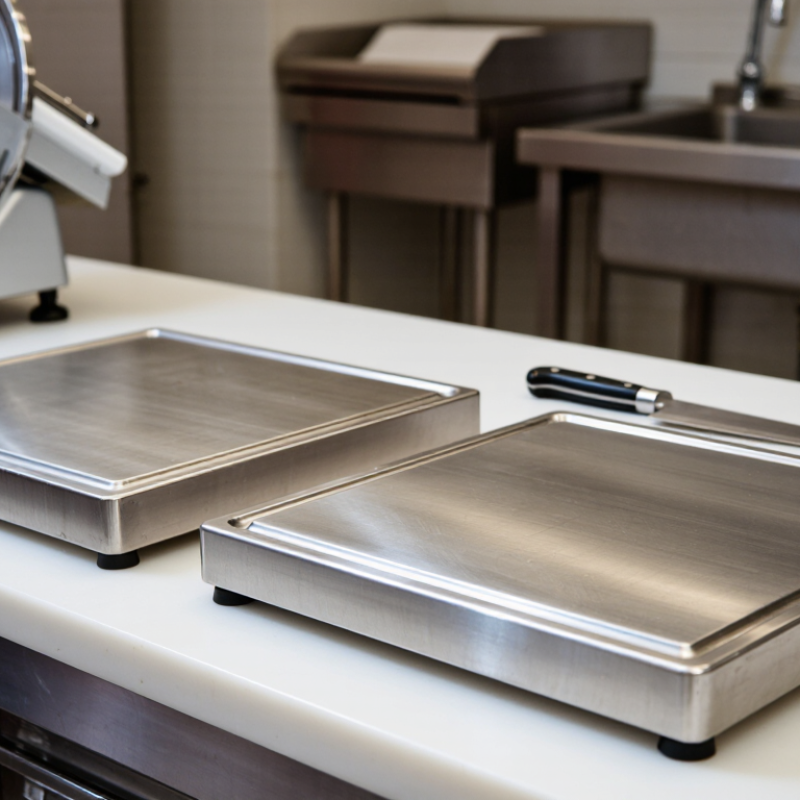
Types of Metal Cutting Boards for Bulk Purchasing
Bulk buyers usually choose among stainless steel, aluminum, and titanium cutting boards. Stainless steel remains the practical workhorse because it resists corrosion, absorbs no juices, and tolerates repeated commercial washing. Type 304 suits most kitchens. Type 316 offers better resistance around salt, brine, and acidic ingredients. It costs more. Aluminum is lighter and easier to move between prep stations, but softer surfaces can scratch and deform sooner. Titanium is strong and corrosion-resistant, yet its higher purchase price often limits it to specialized operations.
Surface finish matters as much as metal type. The FDA Food Code 2022 requires food-contact surfaces to be smooth, durable, nonabsorbent, and easily cleanable. It also sets cold holding at 41°F (5°C) or below, making fast cleaning and drying important between batches. NSF/ANSI 51 is commonly used to evaluate food-equipment materials, finishes, and cleanability. Buyers should request material certificates, thickness measurements, edge details, and sanitation instructions. Do not rely on appearance alone.
In my experience, a 2–3 mm stainless board balances rigidity, handling, and storage for many bulk orders. Thicker plates feel stable but increase shipping weight. Raised lips can contain liquid, while textured undersides improve grip. Still, texture may trap residue if cleaning is rushed. That is the uncomfortable trade-off. Aluminum may reduce labor during transport, but it can show deep knife marks faster. Test a sample through real washing cycles before ordering hundreds. A specification sheet cannot reveal every daily weakness.
What Is the Best Metal Cutting Board for Bulk Buyers? - Types of Metal Cutting Boards for Bulk Purchasing
| Metal Cutting Board Type | Common Food-Contact Material | Typical Thickness | Approximate Weight at 600 × 400 mm | Corrosion Resistance | Knife Impact | Cleaning and Sanitation | Bulk-Buying Advantages | Main Limitations | Best-Fit Purchasing Scenario |
|---|---|---|---|---|---|---|---|---|---|
| Stainless Steel Board | Food-grade 304 stainless steel; 316 may be selected for higher chloride exposure | 2–5 mm for general food preparation; thicker versions offer greater rigidity | Approximately 3.8–9.6 kg, depending on thickness and construction | Excellent in normal food-processing environments; 316 provides improved resistance to chlorides | Hard on knife edges; frequent professional use can accelerate blade dulling | Non-porous, dishwasher-compatible when the design permits, and easy to sanitize; dry after cleaning | Strong durability, consistent quality, broad commercial acceptance, and low maintenance | Heavy; can be noisy; may slide without non-slip feet or a textured underside | Commercial kitchens, seafood handling, butcher preparation, catering, and long-term institutional use |
| Aluminum Board | Food-grade aluminum, often anodized for improved surface hardness | 2–6 mm; anodized surfaces are commonly chosen for better wear resistance | Approximately 1.3–3.9 kg, depending on thickness and design | Good because aluminum forms a protective oxide layer; damaged finishes can reduce protection | Softer than stainless steel and may scratch, dent, or transfer metal marks under hard use | Easy to wash and relatively light; avoid strongly alkaline cleaners that can attack aluminum | Lower shipping weight, easier handling, and reduced load on workstations and storage racks | Can react with highly acidic or alkaline foods; surface wear may be more visible | Mobile food-service kits, lightweight preparation stations, and buyers prioritizing transport efficiency |
| Carbon Steel Board | Plain carbon steel, usually supplied with a protective finish or seasoning requirement | 2–5 mm for flat boards; heavier gauges are available for industrial work surfaces | Approximately 3.8–9.4 kg, depending on thickness and steel density | Moderate to low unless properly seasoned, coated, dried, and maintained | Hard and durable, but the surface may develop scratches and requires regular care | Must be washed, dried promptly, and periodically reseasoned if uncoated; not ideal for unattended wet storage | High structural strength and potentially long service life where maintenance procedures are controlled | Rust risk, maintenance labor, and possible incompatibility with acidic or high-moisture foods | Controlled production environments, specialty food preparation, and buyers with documented maintenance routines |
| Titanium Board | Commercially pure titanium or food-contact titanium alloy, subject to supplier documentation | 1–3 mm for lightweight designs; thicker plates provide greater rigidity | Approximately 1.5–4.9 kg, depending on thickness and construction | Excellent; titanium forms a highly stable oxide layer and resists many corrosive environments | Very durable and relatively light, but still harder on knives than wood or soft plastic | Non-porous and easy to clean; follow the supplier’s guidance for detergents and sanitizing chemicals | Low weight-to-strength ratio, excellent corrosion resistance, and premium long-term performance | High material and fabrication cost; fewer standard sizes and finishes are commonly available | Specialty processing, laboratory-adjacent food applications, harsh environments, and premium procurement programs |
| Perforated Stainless Steel Board | Food-grade stainless steel, commonly 304 or 316 depending on the environment | 1.5–4 mm sheet with drainage holes or slots | Usually 10–30% lighter than a solid board of the same outer dimensions, depending on perforation | Excellent when the correct stainless grade and finish are selected | Similar knife impact to solid stainless steel; perforations may catch blade tips | Improved drainage and airflow, but holes require thorough rinsing and inspection | Lower material weight, faster drainage, and useful separation of liquids from prepared food | More difficult to clean if perforations are small or poorly finished; unsuitable for fine chopping | Produce washing, draining, seafood preparation, and applications where liquid separation is important |
Key Material and Construction Factors to Compare
For bulk buyers, the best metal cutting board depends on workload, food type, and cleaning routines. Material choice controls durability, weight, noise, and maintenance. Stainless steel usually offers strong corrosion resistance and a stable cutting surface. It suits busy kitchens that handle moisture, acidic foods, and frequent sanitation. Aluminum is lighter and easier to move, but it can show dents and scratches sooner. That trade-off may matter in large food preparation areas.
Construction deserves equal attention. Look for a flat, thick sheet with smoothly finished edges. Sharp corners can damage gloves or collect residue. Welded joints should appear even and closed, without pits or rough gaps. A brushed finish may hide scratches better than a mirror finish, although it can still retain residue when poorly cleaned. I once assumed greater thickness always meant better quality. It did not. Excess weight made daily handling slower and increased storage problems.
Tips: Request samples before placing a large order. Test the board under real cutting, washing, and stacking conditions. Check whether it stays flat after heating and cooling. Measure the actual thickness, not only the advertised specification. Ask for food-contact documentation and cleaning guidance suitable for your operating region. Also inspect packaging, because bent corners can turn good materials into unusable stock. Small details matter.
Evaluating Hygiene, Safety, and Cutting Performance
What Is the Best Metal Cutting Board for Bulk Buyers?
For bulk buyers, hygiene and safety should guide the decision before price. A stainless steel cutting board has a smooth, nonporous surface. It does not absorb meat juices, vegetable moisture, or cleaning chemicals. However, metal is not automatically hygienic. Workers must wash it with approved detergent, rinse it, and sanitize it between food categories. Drying matters too. Standing water can encourage contamination around seams or edges.
Safety depends on design, not metal alone. Choose a board with rounded corners, stable weight, and a non-slip underside. A sliding board can cause serious hand injuries during fast preparation. Check whether the surface remains stable on wet counters. Thin boards may be easier to store, but they can bend or create sharp edges. That trade-off is easy to overlook. Cutting performance also needs honest evaluation. Metal resists stains and deep grooves, yet it can produce loud impacts and dull knives faster than softer surfaces. It may suit portioning tasks, but it can feel harsh during long vegetable-preparation shifts.
Tips: Ask for sample testing before placing a large order. Cut firm vegetables, trim protein, and inspect the board after repeated cleaning. Check knife wear, surface scratches, noise, and worker comfort. No board wins every category. Bulk buyers should record these results instead of trusting specifications alone.
Assessing Size, Durability, and Maintenance Needs
For bulk buyers, size should match workflow, not merely available storage space. Measure the workbench, sink, racks, and cleaning area before ordering. A 600-by-400-millimeter board suits many preparation stations, but larger boards may create lifting and washing problems. Small boards can multiply handling time. That sounds tidy. It can be wrong.
Durability depends on more than metal thickness. Food-contact documentation, smooth welds, rounded corners, and stable feet deserve equal attention. Stainless steel resists corrosion, but repeated knife impact can increase noise and dull blades faster than softer surfaces. Request sample units before placing a large order. Check warping after heating, edge sharpness, drainage, and compatibility with existing racks. A thicker board may last longer, yet its weight can raise labor and cleaning demands.
Maintenance must fit the site’s real routine. The FDA Food Code 2022, Section 4-602.11, requires food-contact surfaces handling temperature-controlled foods to be cleaned at least every four hours. USDA FSIS guidance recommends washing cutting boards with hot, soapy water after each food item. In practice, visible residue often hides around feet and seams. Removable supports help. Fixed hardware does not. Specify surfaces that tolerate approved detergents, thorough rinsing, and air-drying without trapping moisture. NSF/ANSI 2 certification can support equipment evaluation, but it should not replace hands-on inspection. My first specification would likely overvalue thickness; maintenance access often determines the real service life.
Comparing Costs, Suppliers, and Bulk Order Value
For bulk buyers, 304 stainless steel is usually the safer metal cutting board choice. It resists corrosion, repeated washing, and acidic foods. However, it can dull knives faster than food-grade polymer surfaces. The International Stainless Steel Forum reported about 58.4 million tonnes of global stainless steel production in 2023. That scale supports stable sourcing, but does not guarantee consistent quality.
Cost changes sharply with order volume. A practical quotation may reach $18 per board at 100 units, then fall near $12 at 500 units. Freight, protective packaging, and custom dimensions can reverse that saving. Buyers should request thickness, surface finish, edge treatment, and food-contact documentation. The USDA Food Safety and Inspection Service emphasizes cleanable, durable food-contact equipment in processing environments. A smooth surface matters more than a bright appearance.
Supplier comparison needs more than the unit price. Check production samples, tolerance records, inspection photos, and replacement terms. Ask whether the supplier can maintain the same alloy and thickness across repeat orders. My early purchasing spreadsheet missed pallet space and import handling fees. That mistake looked small. It was not. A 500-piece order may offer strong value, yet only when storage, knife wear, and cleaning labor fit the operating budget. Bulk buyers should also test one small batch before approving a larger contract.
