China Top 10 Intelligent WC Toilet Manufacturers
China’s intelligent bathroom market is moving from novelty toward everyday utility. Grand View Research estimated the global smart toilet market at USD 8.8 billion in 2023, with projected growth through 2030. These figures cover a broad product category, not China alone, so they should be read as context rather than a direct forecast for Chinese manufacturers. Still, the direction is clear: consumers increasingly expect heated seats, bidet washing, warm-air drying, and automatic flushing in one fixture.
The phrase Intelligent Wc Toilet can describe products with very different levels of technology. Some focus on simple comfort; others add touchless controls, self-cleaning functions, or remote diagnostics. As Jack Sim, founder of the World Toilet Organization, has said, “We need to make toilets sexy.” Design matters. Yet reliable cleaning, water use, maintenance access, and clear product support matter just as much. A sleek control panel is less impressive when replacement parts are difficult to find.
This guide examines China’s top 10 intelligent WC toilet manufacturers through practical questions: What functions do they offer? Which markets do they serve? How do they approach product quality and after-sales support? Company materials can help, but they are not independent performance tests. Buyers should verify specifications, certifications, and service coverage before making comparisons. The market is growing, but claims do not always tell the whole story. A careful shortlist can reveal which suppliers combine useful features with dependable manufacturing.
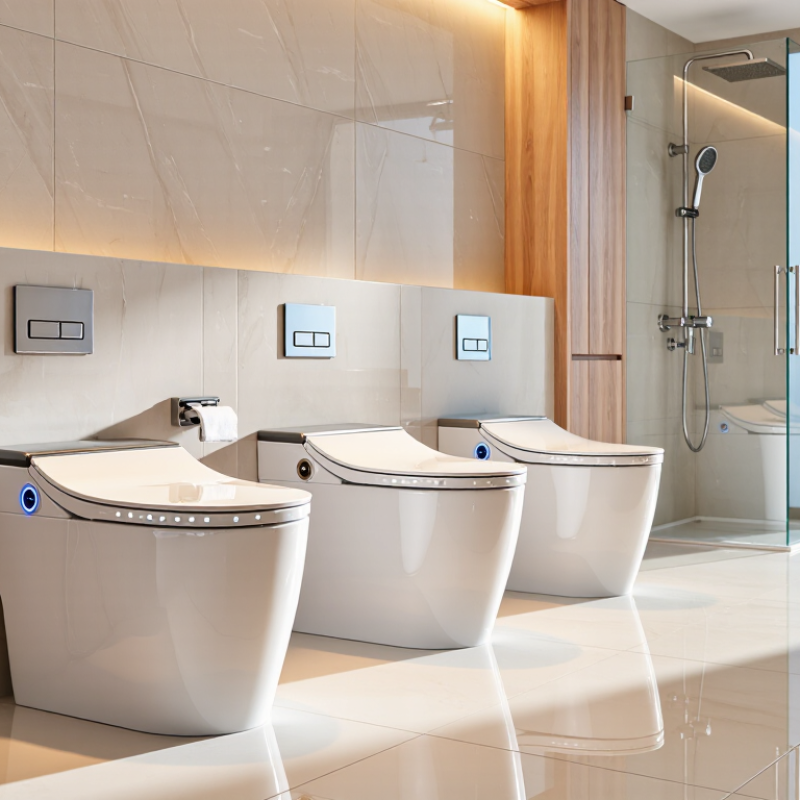
How Intelligent WC Toilets Are Designed and Manufactured in China
Designing an intelligent WC toilet in China starts with more than adding sensors to a ceramic bowl. Product teams map user needs, bathroom dimensions, water pressure, and cleaning access before fixing the layout. They consider seat height, nozzle reach, control placement, and safe separation between water and electrical parts. Small details matter.
Manufacturing often begins with ceramic forming, drying, glazing, and kiln firing. Technicians check dimensions and surface finish because small distortions can affect installation or flushing. Meanwhile, electronic modules, heated seats, sensors, and washing components are assembled and tested. A compact prototype may reveal awkward controls or a nozzle position that feels wrong in actual use. That feedback can lead to changes before larger production runs.
At final assembly, workers connect the ceramic body, water pathways, wiring, and seat mechanism. Quality checks may include leak tests, flushing performance, sensor response, temperature control, and repeated seat operation. Testing under different water pressures is useful, but no factory test perfectly reflects every home. One overlooked issue can be service access: a tidy exterior may hide parts that are difficult to inspect. For manufacturers, balancing comfort, reliability, cleaning, and repairability remains practical work, not a one-time design decision.
Criteria for Identifying Leading Chinese Manufacturers
When assessing Chinese intelligent WC toilet manufacturers, look beyond polished catalogs. A capable factory should explain its ceramic body process, glazing checks, and leak-testing routine in clear terms. Ask how each unit is tested before packing, and request sample inspection records. Details matter: a stable seat, evenly heated water, and a lid that opens without scraping can reveal more than a long feature list.
Check whether the manufacturer can document key component specifications, water and power requirements, and routine maintenance steps. Ask about production capacity, quality-control staff, spare-part availability, and response times for technical questions. If answers change between sales and engineering teams, pause. That is not proof of poor quality, but it deserves follow-up. Factory visits or third-party inspections can help verify what documents alone cannot.
Tips: Compare the same test points across suppliers. Request a sample, then check flushing consistency, nozzle movement, drying time, and noise in a real bathroom. Keep notes. Small differences add up.
Also consider installation conditions. Confirm the required water pressure, outlet position, and electrical connection before choosing a model. Ask how the manufacturer handles defects found after delivery. A reliable partner should describe the process plainly, not promise that nothing will ever go wrong. Even strong factories have limits, so verify claims and record agreed specifications in writing.
Profiles of China's Top 10 Intelligent WC Toilet Manufacturers
Profiles of China’s top 10 intelligent WC toilet manufacturers are most useful when they show how each factory works, not just what its products promise. Key comparisons include ceramic-body production, electronic module sourcing, assembly capacity, and inspection procedures. Ask whether water-pressure testing, seat-heating checks, and sensor calibration happen on every unit or only sampled batches. Small details matter.
The ten profiles can highlight different strengths: some manufacturers focus on in-house ceramic production, while others specialize in electronic controls, export orders, or customized designs. Look for clear information about product development, component traceability, warranty handling, and the availability of replacement parts. A factory visit or a recent production sample can reveal more than polished catalogue images. It is easy to overlook this.
A careful profile should also describe limits. Intelligent functions may vary between models, and installation needs can depend on local plumbing and water pressure. Buyers should compare specifications against real project requirements rather than assume every feature suits every bathroom. Published figures deserve verification through technical documents and sample testing. No profile tells the whole story; factory conditions and product revisions can change. That is worth remembering.
| Profile | Manufacturing Focus | Typical Product Capabilities | Relevant Production Considerations | Potential Buyer Fit |
|---|---|---|---|---|
| Profile 01 Ceramics + electronics | Integrated production of ceramic toilet bodies and electronic toilet components. | One-piece smart toilets or ceramic toilets paired with integrated bidet-seat functions; feature options vary by model. | Requires coordination between ceramic-body production, electronic assembly, and finished-product testing. | Buyers seeking a coordinated product range from a single manufacturing source. |
| Profile 02 Smart-seat specialist | Electronic bidet seats designed for use with compatible toilet bowls. | Common options may include seat heating, warm-water washing, adjustable spray, and air drying. | Compatibility with bowl shape, electrical safety, water connections, and serviceability should be checked. | Projects that need smart-seat options for existing or separately sourced ceramic toilets. |
| Profile 03 Flushing-system focus | Toilet-body and flushing-system development, including water-conserving designs. | Model-specific flushing arrangements and bowl designs intended to clear waste effectively with controlled water use. | Compare flush performance, water consumption, drainage compatibility, and installation requirements by model. | Buyers prioritizing flushing performance and plumbing compatibility. |
| Profile 04 Compact-space products | Space-conscious toilet and smart-seat configurations for smaller bathrooms. | Compact dimensions and selected automated washing or comfort functions, depending on the product specification. | Confirm rough-in distance, overall dimensions, lid clearance, and access to power and water before ordering. | Apartment, renovation, and small-bathroom projects. |
| Profile 05 Hygiene-oriented designs | Products emphasizing cleanable surfaces and hygiene-related user functions. | Depending on the model, options may include nozzle cleaning, replaceable or self-cleaning nozzle features, and seat materials designed for routine cleaning. | Ask for the exact cleaning method and maintenance instructions; feature names alone do not establish hygiene performance. | Residential and hospitality buyers with clearly defined cleaning and maintenance needs. |
| Profile 06 Comfort-feature range | Intelligent toilets combining core washing functions with user comfort options. | Possible options include heated seating, adjustable water temperature or pressure, warm-air drying, and user controls. | Compare available adjustment ranges, control layout, power requirements, and feature availability across models. | Retailers and residential projects seeking multiple feature tiers. |
| Profile 07 Connected-control products | Smart toilets with electronic control systems and model-dependent connectivity features. | Controls may be provided through a side panel, remote control, or other specified interface; connectivity is not universal. | Verify supported functions, language options, wireless requirements, software support, and after-sales arrangements. | Buyers who need particular control methods or connected-home integration. |
| Profile 08 Commercial-duty range | Product configurations intended for higher-use environments such as hotels or other managed facilities. | Commercial suitability depends on the specific model, installation design, and maintenance plan; residential features may differ. | Assess expected usage, cleaning frequency, replacement-part supply, warranty terms, and service response. | Hospitality and property-management projects requiring defined lifecycle support. |
| Profile 09 Export-oriented production | Manufacturing configured for orders with market-specific packaging, documentation, and product requirements. | Electrical versions, plugs, language labels, and product configurations should be confirmed for the destination market. | Request current, model-specific test reports and certificates applicable to the importing country; do not assume they cover every model. | Importers and distributors sourcing products for overseas markets. |
| Profile 10 OEM / ODM production | Contract manufacturing or product development based on buyer-provided specifications and order requirements. | Customization may cover appearance, controls, packaging, or selected functions, subject to tooling and production feasibility. | Agree on approved samples, bill of materials, quality checks, intellectual-property terms, lead times, and change control. | Private-label buyers and distributors developing differentiated product lines. |
Comparing Product Features, Certifications, and Manufacturing Capabilities
When comparing China’s top intelligent WC toilet manufacturers, look beyond touchscreens and heated seats. Check how reliably each model handles flushing, water temperature, seat heating, and automatic lid functions. Ask for test data on water use, noise, and performance under different water pressures. Small details matter. A control panel should remain readable in a steamy bathroom, and replacement parts should be clearly identified.
Certifications can help assess quality, but their scope matters. Request current certificates and confirm they cover the exact product model and factory, not just a related product line. Ask how electrical safety, water resistance, and quality checks are documented. Do not treat a certificate image as proof by itself. Verify issuing details through the relevant certification body where possible.
Manufacturing capability is equally practical. Compare monthly output, production lead times, customization limits, and inspection procedures. A useful factory visit or audit should show assembly stations, water and electrical testing, and traceable batch records. Ask how defects are handled after shipment, too. Answers may sound polished; request examples and written procedures. I would also compare spare-part availability, since this is easy to overlook during a showroom demonstration. Not always obvious. A feature-rich toilet can still disappoint if service support is slow or model specifications change between samples and bulk orders.
How to Choose a Manufacturer for Different Markets and Projects
Choosing a Chinese intelligent WC toilet manufacturer should begin with project conditions, not a showroom feature list. Hotels, apartments, and care facilities differ in seat height, cleaning access, daily cycles, and service needs. Ask suppliers to match each model to users, water pressure, and installation constraints. Small details matter.
For U.S. projects, use a measurable water benchmark. The U.S. EPA WaterSense specification caps labeled toilets at 1.28 gallons per flush, 20% below the 1.6-gallon federal baseline. Compare independent flush-performance evidence with water use; low consumption means little if a unit struggles with local pressure or drain layouts. Elsewhere, check local efficiency and electrical requirements instead of copying U.S. assumptions.
Before ordering, request factory audit records, component warranties, pilot results, and a dated spare-parts plan. Check that controls, replacement valves, and support suit the destination market. Test before scaling. Lab tests cannot predict every site’s maintenance habits, so visit a working installation and confirm who handles faults after handover.
Urban Population Share by Region (2023)
Urbanization provides useful context when assessing intelligent WC opportunities: regions with larger urban populations may have more high-density housing and commercial projects. This indicator is not a direct measure of product demand. Figures are rounded regional estimates from the World Bank’s World Development Indicators.
