
Top Private Label Bedding Suppliers in China
China’s bedding industry offers a wide range of options for brands building a Private Label Bedding collection. Factories may produce cotton sheets, duvet covers, pillowcases, mattress protectors, and coordinated sets. The right supplier is not simply the one with the lowest quotation. Fabric feel, stitching, color consistency, packaging, and sample accuracy all matter. One detail can change the result.
“Ask how the approved sample will be matched in bulk production, not just how attractive it looks today,” says Lin Wei, a fictional composite sourcing specialist created for this introduction. This is an editorial perspective, not a verified quotation from a real industry professional. Buyers can use it as a practical prompt when comparing suppliers. Request fabric specifications, review physical samples, and clarify labeling and packaging requirements before confirming an order. A neat sample is encouraging. Consistent production is the real test.
This outline examines leading Chinese suppliers, their product capabilities, customization options, quality-control practices, and communication standards. It also considers order quantities, lead times, and the questions buyers should ask before choosing a partner. Supplier claims deserve careful review. I would not treat a polished catalog as proof of reliable production; that assumption is easy to make, and easy to regret.
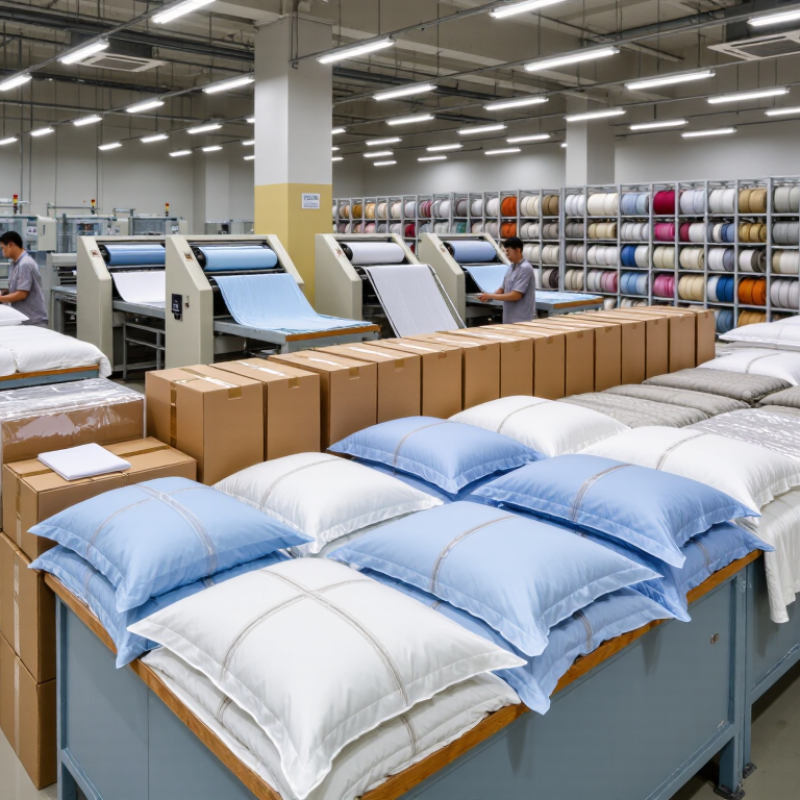
Private-Label Bedding in China: Product Scope, OEM, and ODM Models
Private-label bedding suppliers in China typically cover sheet sets, duvet covers, pillowcases, quilts, mattress protectors, and decorative cushions. The product brief should specify fabric composition, weave, dimensions, stitching, labeling, and packaging. Grand View Research valued the global bedding market at about US$79.6 billion in 2023 and projected 6.5% annual growth through 2030. This is a global estimate, not a China-specific forecast, but it signals broad demand for differentiated bedding.
OEM suits buyers who already have designs, technical specifications, and packaging artwork. The supplier manufactures against those requirements, so clear measurement charts and approved samples matter. ODM suppliers can develop fabric, construction, and design options for a buyer’s label. Textile Exchange’s Materials Market Report 2024 estimated global fiber production at 124 million tonnes in 2023, with polyester accounting for roughly 57%. Fiber choice affects feel, care instructions, and price. The statistic covers all textiles, not bedding alone.
Ask suppliers for fabric test results, production tolerances, sample lead times, and inspection checkpoints. Check shrinkage after washing, seam strength, color consistency, and whether fitted sheets hold a mattress corner. Small details matter. A showroom sample can look excellent, yet bulk fabric may vary between dye lots. That risk deserves a written approval process. Be realistic: one sample cannot prove every production run will match.
Top Private Label Bedding Suppliers in China - Private-Label Bedding in China: Product Scope, OEM, and ODM Models
| Dimension | Typical Product Scope | OEM Model | ODM Model | Buyer Checks |
|---|---|---|---|---|
| Bed linen | Flat sheets, fitted sheets, pillowcases, and coordinated sheet sets. | Manufactured to the buyer’s fabric, size, color, labeling, and packaging specifications. | Supplier-developed fabric, color, print, or set configurations adapted for the buyer. | Confirm mattress dimensions, pocket depth, shrinkage allowance, fabric composition, and colorfastness requirements. |
| Duvet covers and comforter covers | Single-piece covers and coordinated duvet cover sets with pillow shams or pillowcases. | Buyer supplies the design and specifications; production follows approved samples and construction details. | Supplier proposes available designs, fabric options, trims, and closure details for buyer selection. | Specify finished measurements, closure type, internal ties, seam construction, and set contents. |
| Comforters and duvet inserts | Filled bedding products using specified shell fabrics and filling materials, including synthetic fills or down and feather where offered. | Buyer defines filling, fill weight, dimensions, shell fabric, quilting, and labeling requirements. | Supplier offers existing fill and construction options that can be adjusted for the target market. | Review fill composition, fill weight, construction, care instructions, and applicable market rules for down or feather products. |
| Pillows and pillow protectors | Sleeping pillows and removable protectors in selected sizes, fabrics, and fill types. | Production follows buyer-defined dimensions, fill, loft, cover fabric, closure, and packaging specifications. | Supplier presents standard pillow constructions and protector options for selection or adaptation. | Check fill labeling, finished size, firmness or loft criteria, washability, and packaging compression requirements. |
| Mattress protectors and pads | Fitted or flat protectors and quilted mattress pads, with material and barrier features varying by specification. | Buyer specifies top fabric, backing or barrier layer, skirt, dimensions, and performance requirements. | Supplier provides existing material and construction combinations for customization. | Define the meaning of claims such as waterproof or breathable and request relevant test results for the finished product. |
| Fabric and construction options | Common options include cotton, polyester, and blended fabrics; woven constructions and finishes depend on the product and supplier capability. | Buyer selects or specifies composition, construction, finish, color, and target fabric weight. | Supplier recommends available fabrics, constructions, and finishes from its development range. | Verify composition and performance claims through product specifications, samples, and appropriate laboratory testing. |
| Sampling and product development | Development may include fabric or color swatches, size samples, construction samples, and pre-production samples. | Samples are prepared against buyer-provided specifications and approved before bulk production. | Supplier contributes concepts or existing designs, with revisions agreed during development. | Approve a written specification and reference sample; confirm sample charges, revision limits, and lead times directly. |
| Private-label packaging | Packaging can include sewn-in labels, hangtags, inserts, barcode labels, and retail or export packing, subject to supplier capability. | Buyer provides artwork, label content, packaging format, and any required barcode information. | Supplier may offer standard packaging formats and help adapt artwork or packaging layouts. | Check language, fiber and care information, country-of-origin marking, barcode placement, and destination-market requirements. |
| Order terms and quality control | Minimum order quantities, production lead times, payment terms, and inspection arrangements vary by supplier, material, and order details. | Order parameters are agreed against the buyer’s product specification and approved sample. | Development requirements and order terms depend on the selected design and level of customization. | Obtain written confirmation of MOQ, lead time, tolerances, inspection criteria, defect handling, and shipment terms before ordering. |
Note: Product availability, customization options, certifications, minimum order quantities, and production timelines vary by supplier and order. Confirm all specifications and compliance documentation for the intended sales market before purchase.