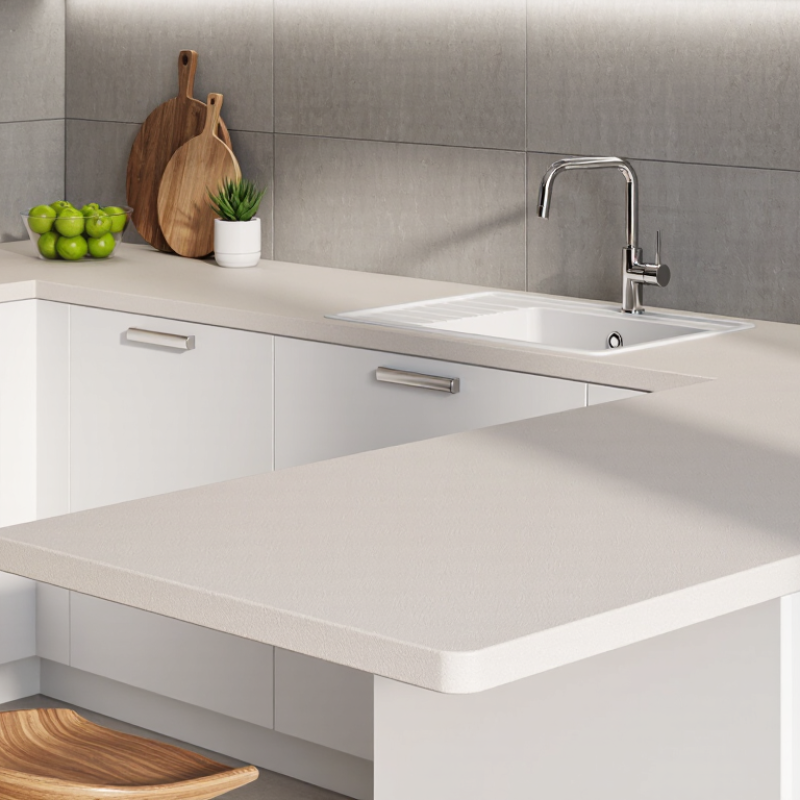
| Basic Definition | A homogeneous, nonporous surfacing material | Solid surface countertops are manufactured sheets or molded components made from a resin binder and mineral-based fillers. Their composition is consistent through the material rather than being a thin decorative layer over a different core. |
| Primary Binder | Acrylic, polyester, or an acrylic-polyester blend | The resin binds the mineral particles together and gives the countertop its shape, color distribution, workability, and resistance to moisture. Acrylic-based formulations are commonly valued for thermoforming and repairability. |
| Mineral Filler | Alumina trihydrate and other mineral fillers | Mineral fillers add body, stiffness, opacity, and surface performance. Alumina trihydrate is widely used because it is a fine white mineral that can be blended into resin systems. |
| Pigments and Decorative Additives | Color pigments, particles, and visual effects | Pigments and particulate additives create solid colors, speckled patterns, translucent effects, or stone-like appearances. The pattern generally extends through the sheet, allowing the surface to be refinished. |
| Surface Porosity | Nonporous when properly fabricated and maintained | The dense surface does not readily absorb ordinary household liquids. This helps limit the retention of stains and odors and makes routine cleaning relatively simple. |
| Typical Sheet Thickness | Approximately 6 to 13 mm for standard sheets | Many solid surface sheets are produced in thicknesses around 6 mm or 12 mm, although available dimensions vary by product specification and application. Thicker visual edges can be fabricated by laminating pieces together. |
| Seam Appearance | Seams can be made visually inconspicuous | Fabricators commonly join sections with color-matched adhesive and then sand the joint flush. Seam visibility depends on color, pattern, workmanship, lighting, and the condition of the finished surface. |
| Edge and Sink Integration | Suitable for formed edges and integrated sinks | Because the material can be machined and, for suitable acrylic formulations, heated and shaped, it can be used for coved backsplashes, custom edge profiles, and integrated sink designs. |
| Repairability | Many light scratches and minor blemishes can be refinished | The surface can often be sanded or polished to reduce the appearance of superficial scratches, scuffs, and small marks. Deep damage may require a qualified fabricator to patch or replace the affected section. |
| Scratch Resistance | Moderate; cutting directly on the surface is not recommended | Solid surface is durable for normal countertop use, but it is generally softer than many natural stones and engineered quartz surfaces. Cutting boards should be used to protect the finish. |
| Heat Performance | Sensitive to direct or prolonged high heat | Hot cookware, appliances, and heat-generating equipment can discolor, deform, or damage the resin matrix. Trivets or heat pads should be placed under hot objects. |
| Water and Moisture Performance | Good resistance to routine moisture exposure | The nonporous surface is suitable for kitchens, bathrooms, reception areas, and other indoor environments where regular contact with water is expected, provided seams and cutouts are correctly fabricated. |
| Cleaning Requirements | Routine cleaning with mild soap and water | Most everyday dirt can be removed with a soft cloth or sponge and a mild household cleaner. Abrasive pads and harsh chemicals may alter the finish, especially on polished or darker surfaces. |
| Common Applications | Kitchen counters, bathroom vanities, worktops, wall cladding, and service areas | Its seamless fabrication options, moisture resistance, and repairability make solid surface suitable for residential, commercial, healthcare, hospitality, and institutional interiors. |
| Indoor Use and UV Exposure | Primarily intended for interior applications | Extended exposure to direct sunlight can affect color stability and may increase thermal stress. Outdoor suitability should be confirmed from the material specification before installation. |
| Key Distinction from Natural Stone | Manufactured resin-and-mineral composite rather than quarried stone | Unlike granite or marble, solid surface is produced under controlled manufacturing conditions. It offers consistent composition, customizable fabrication, and repairable surface characteristics, but it requires more protection from high heat. |